Key takeaways
- A single-acting cylinder has one port and a double-acting cylinder has two
- A 50 mm cylinder at 6 bar pushes with about 1,178 N and pulls with about 990 N, before friction
- Always size for the pulling stroke too, because the rod takes up area
- ISO 15552 cylinders from different makers share mounting dimensions
On this page
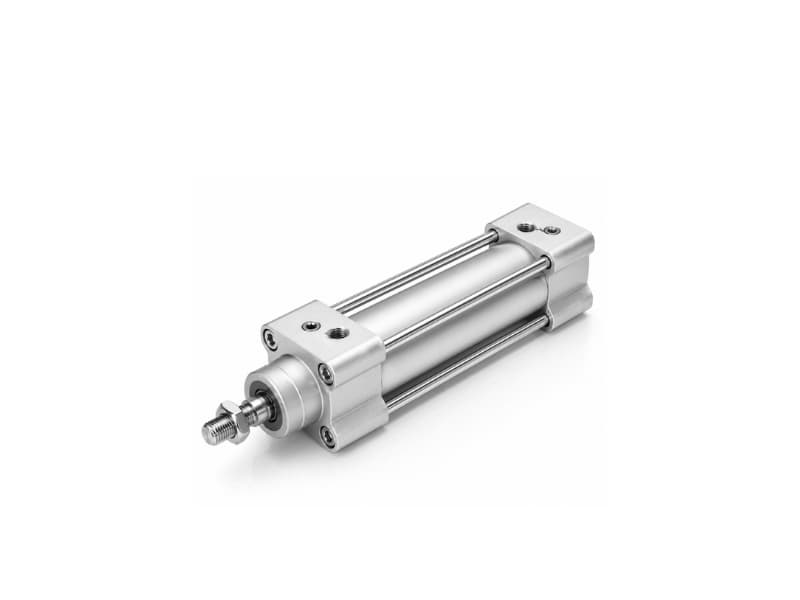
A pneumatic cylinder turns compressed air into straight-line motion. It is one of the most common parts in factory automation, and choosing the wrong type or size is a common cause of slow, weak or unreliable machines. This guide explains the main types, shows how to calculate the force a cylinder produces, and checks the numbers against the manufacturer's own data.
What a pneumatic cylinder does
According to Wikipedia, a pneumatic cylinder (also called an air cylinder) uses the power of compressed gas to produce a force in a reciprocating linear motion. Air pushes on a piston, and the piston rod carries that force to the load. Engineers often choose pneumatics because they are quieter and cleaner than hydraulics, and leaking air does not drip onto the surroundings. The concept is also recorded in Wikidata (Q4567087).
Single-acting and double-acting cylinders
The two most common types differ in how many ports they have.
| Feature | Single-acting | Double-acting |
|---|---|---|
| Ports | One | Two |
| Air drives the rod | In one direction only | Both out and back |
| Return stroke | When air leaves through the same port | Driven by air on the other side of the piston |
| Best for | Simple push or clamp jobs | Machines that need force in both directions |
A single-acting cylinder has one port. Compressed air extends the rod, and when the air leaves through the same port the rod returns. A double-acting cylinder has two ports, one for the outstroke and one for the instroke, and uses air to move in both directions. Wikipedia notes that a double-acting design is not limited in stroke length, but the longer piston rod is more vulnerable to buckling and bending, so extra calculations are needed.
Standard (profile) cylinders and ISO 15552
For general machinery, most buyers use standard cylinders built to an international standard, because they can be swapped between makers. ISO 15552 (second edition, 2018) covers cylinders with detachable mountings, in the 1,000 kPa (10 bar) series, with bores from 32 mm to 320 mm. It sets the basic, mounting and accessory dimensions.
Festo's standard cylinder range, the DSBC, is built to ISO 15552. Its catalogue data sheet lists piston diameters of 32, 40, 50, 63, 80, 100 and 125 mm, and offers sensor slots on three sides and adjustable pneumatic cushioning at both ends as options. The data sheet we checked is the December 2013 edition (Festo DSBC data sheet, PDF), so confirm the current range on festo.com before you order.
Compact cylinders
Where space is tight, compact cylinders are designed for short installation lengths. They are covered by a separate standard, ISO 21287, for compact cylinders in the 10 bar series with bores from 20 mm to 100 mm. Choose them when the installation length is the limit, and a standard profile cylinder when you need longer strokes and heavier loads.
How to calculate the force of a cylinder
The theoretical force is the air pressure multiplied by the area the air acts on:
F = p × A, where A = π/4 × D² on the outstroke.
On the instroke the piston rod takes up part of the area, so the pulling force is smaller:
F = p × π/4 × (D² − d²), where D is the bore and d is the rod diameter.
Use consistent units. One bar is 0.1 N/mm², so 6 bar is 0.6 N/mm².
Worked example: a 50 mm cylinder at 6 bar
The bore is 50 mm and, for this size, the rod is 20 mm.
- Piston area = π/4 × 50² = 1,963.5 mm²
- Pushing force = 0.6 × 1,963.5 = 1,178 N
- Rod area = π/4 × 20² = 314.2 mm²
- Annulus area on the instroke = 1,963.5 − 314.2 = 1,649.3 mm²
- Pulling force = 0.6 × 1,649.3 = 990 N
These results match Festo's published figures for the DSBC-50 at 6 bar: 1,178 N advancing and 990 N retracting. We recalculated every size in the table below and each one agrees with the data sheet to the nearest newton.
| Bore (mm) | Rod (mm) | Push at 6 bar (N) | Pull at 6 bar (N) |
|---|---|---|---|
| 32 | 12 | 483 | 415 |
| 40 | 16 | 754 | 633 |
| 50 | 20 | 1,178 | 990 |
| 63 | 20 | 1,870 | 1,682 |
| 80 | 25 | 3,016 | 2,721 |
| 100 | 25 | 4,712 | 4,418 |
| 125 | 32 | 7,363 | 6,881 |
Forces are from Festo's DSBC data sheet. The rod sizes are worked out from those forces and agree with the formula above.
Why the margin matters: lifting a 100 kg load
A 100 kg load has a weight of 100 × 9.81 = 981 N. If a 50 mm cylinder lifts it on the instroke, the theoretical pull is 990 N, which is only about 1% above the weight (990 ÷ 981 = 1.01). In practice that cylinder would struggle or stall. A 63 mm cylinder pulls with 1,682 N, which is 1.7 times the weight (1,682 ÷ 981 = 1.71), so it has a real margin. Check the final size against the manufacturer's sizing guidance.
How to choose the right cylinder
- Direction of force: if you need force both ways, use a double-acting cylinder, and size it on the weaker (retract) stroke.
- Bore size: pick the bore from the load, the pressure available at the cylinder and a safety margin.
- Stroke: longer strokes need more attention to rod buckling.
- Mounting: standard ISO 15552 dimensions let you change makers without redesigning the mounting.
- Cushioning and sensing: adjustable cushioning softens end-of-stroke impact, and sensor slots let you detect the piston position.
- Installation space: use a compact cylinder if length is limited.
Where to buy Festo cylinders in Delhi NCR
Multiweld Engineering supplies Festo pneumatic cylinders and related pneumatic products to industry across the National Capital Region. Our warehouse is at Kherki Daula in Gurgaon (Wikidata Q238508), close to the industrial town of Manesar (Wikidata Q3273362).
The table shows straight-line distances from Kherki Daula (Wikidata Q6401350), calculated from the published coordinates of each place. Road distances are longer and depend on the route and traffic.
| From Kherki Daula to | Straight-line distance |
|---|---|
| Manesar | about 7 km |
| Gurgaon city centre | about 8 km |
| Faridabad | about 32 km |
| New Delhi | about 32 km |
| Noida | about 38 km |
About the maker: Festo is a German automation company headquartered in Esslingen am Neckar (Wikipedia, Wikidata Q657230). Product data sheets and catalogues are on the official site, festo.com.
Frequently asked questions
What is the difference between a single-acting and a double-acting cylinder?
A single-acting cylinder has one port and is driven by air in one direction only, while the rod returns when the air leaves through the same port. A double-acting cylinder has two ports and uses air to move the rod both out and back.
How do I calculate the force of a pneumatic cylinder?
Multiply the air pressure by the piston area: F = p × π/4 × D². On the return stroke, subtract the rod area from the piston area. For example, a 50 mm cylinder at 6 bar gives about 1,178 N pushing and 990 N pulling in theory, before friction losses.
Why is the real force lower than the calculated force?
The calculated value is a theoretical maximum. Friction in the seals and guides, and a drop in supply pressure while the cylinder moves, reduce the force you actually get, so always choose a cylinder with a clear margin over the load.
Sources and references
- Pneumatic cylinder, Wikipedia and Wikidata Q4567087
- ISO 15552:2018, Pneumatic fluid power: cylinders with detachable mountings, 1,000 kPa (10 bar) series
- ISO 21287:2004, Pneumatic fluid power: compact cylinders, 10 bar series
- Festo standard cylinders DSBC, data sheet (PDF, edition 2013/12)
- Festo official website, Festo on Wikipedia and Wikidata Q657230
- Places: National Capital Region, Gurgaon, Manesar, Kherki Daula, with Wikidata Q238508, Q3273362 and Q6401350
Written by
Multiweld Engineering
Multiweld Engineering Pvt. Ltd. supplies industrial products from leading brands to factories and workshops across Delhi NCR.
Request a quote for Festo pneumatic cylinders
Tell us what you need and the Multiweld Engineering team will get back to you.
Areas we serve: Delhi, Gurgaon, Faridabad, Noida, Greater Noida